In this article, you'll learn how to get around the Schedule page. Every booked job lives here, so it's the fastest way to see who's busy, move work around and book something new without leaving the calendar.
Canceled jobs stay off the calendar unless you ask for them in the filter.
To open the schedule:
- In the menu, click Schedule.
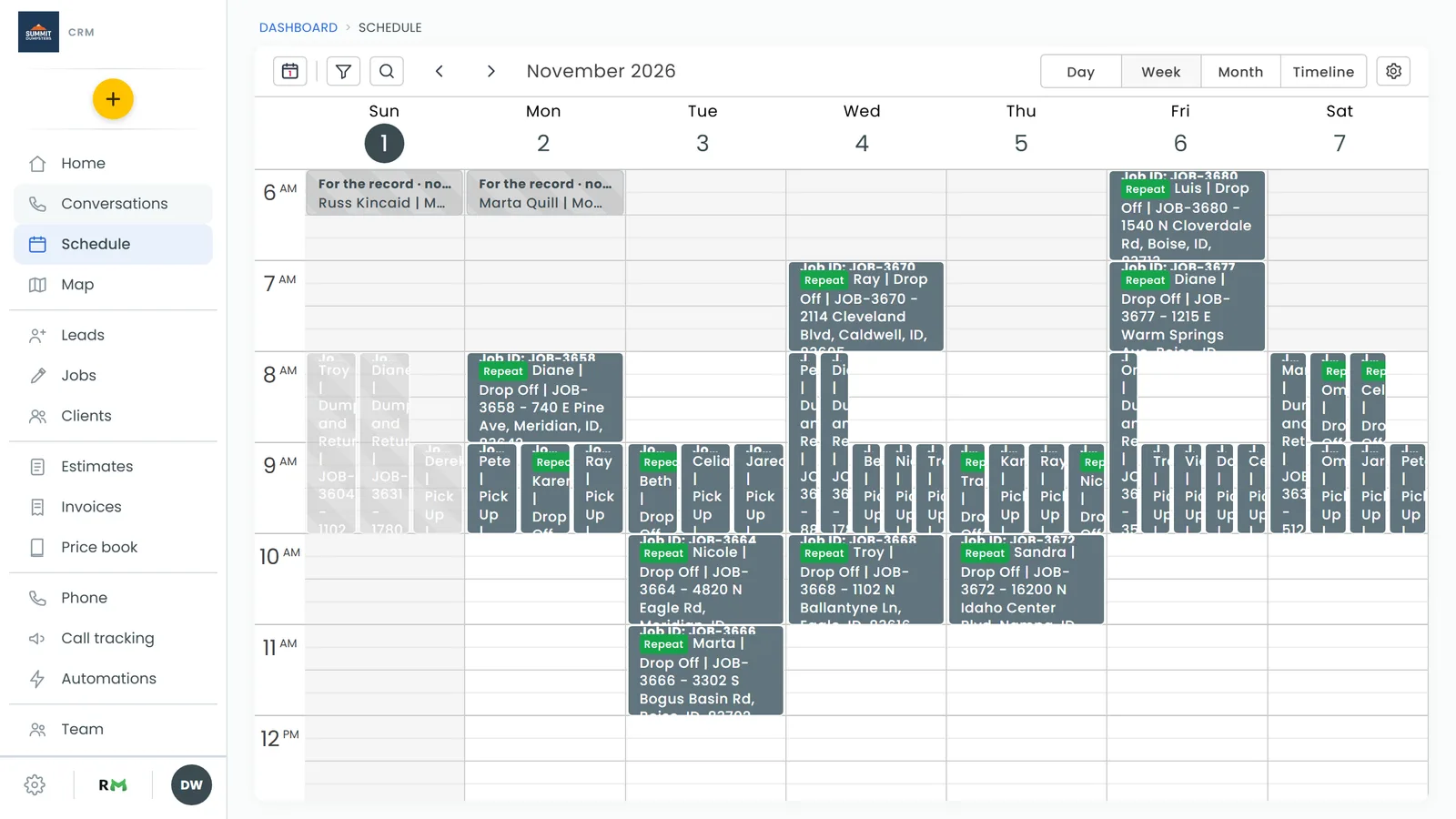
The toolbar
Along the top of the calendar, from left to right:
- Today (the calendar icon with today's date on it): jumps back to today.
- Filter (the funnel): opens Filter the calendar. A small yellow number on the funnel shows how many filters are on.
- Search (the magnifying glass): opens a box that says Search names, numbers, addresses….
- The back and forward arrows: step a day, a week or a month, depending on the view.
- The date you're looking at.
On the right are the view buttons, Day, Week, Month and Timeline, and the gear for Calendar settings.
Switching views
- Click Day, Week, Month or Timeline at the top right.
- Day and Week lay your jobs out on an hour-by-hour grid. Jobs that overlap sit side by side, and a red line marks the current time today.
- Month shows the whole month with one box per day. Each job is one line with its start time. Today has a light red outline, and days outside the month are greyed. A job that runs over several days reads Day 2 of 3 on its later days.
- Timeline shows one day with a row for each team member and an Unassigned row on top. It only spans your open hours for that day, stretched to fill the screen, and widens if a job is booked outside them.
Done jobs stay on the calendar, shaded with grey stripes so you can tell them apart. A job that runs over several days shows on each of those days.
For more on picking a view, see How to schedule and manage jobs.
Filtering and searching
- Click the funnel.
- Tick what you want to see under Team members, Job types, Statuses or Sources, or click a tag under Tags. The calendar updates as you go.
- Click Clear all to show everything again.
To find a job, click the magnifying glass and type a name, phone number, address, job number or tag. Only the jobs that match stay on the calendar. Press Escape to close the box.
Seeing a job's details
- Click any job on the calendar.
A card opens with:
- The job ID.
- The Client. Click the name to open the client. When there's a phone number on file, click it to call, or use the text and call buttons beside it.
- When it's Scheduled.
- The Status, as a dropdown. Pick a new status right there and it saves.
- The Address. Click it to open it in Google Maps.
- Tags and the Description, if the job has them.
At the top of the card, click the pencil (Edit) to go to the job, or the open-in-new-tab icon (Expand) to open the job in a new browser tab.
Moving and resizing jobs
- To move a job, drag it to a new time. In Day and Week you can drop it on another day too. In Month, drag it to another day and it keeps the same start time.
- To make a job longer or shorter, drag its bottom edge in Day and Week, or its right edge in Timeline.
When you let go, the time snaps to the nearest quarter hour and saves on its own. If the save fails, the job jumps back to where it was.
Booking a job from an empty slot
In Day or Week view:
- Click an empty spot to start a one-hour job there, or click and drag down to cover a longer stretch. The times show as you drag.
- The new job form opens with the date, start time and end time already filled in.
- Fill in the rest and save as usual.
For the rest of the form, see How to create jobs.
Business hours and calendar settings
- Click the gear at the top right. Schedule Settings opens.
- Under Business hours, tick Working? for each day you're open and set its Start at and End at. Or switch on Always open or Open on holidays.
- Set the Schedule visible hour range, which is the stretch of hours the Day and Week grids show.
- Click Save.
Hours outside your business hours are shaded on the Day and Week grids. The same settings are also under Settings > Schedule.
Google Calendar events
If you've connected a Google Calendar under Settings > Calendar sync, its events show on the calendar as grey striped blocks labelled Google Calendar · busy, with the event's time and title. They're there so you can see the time is taken. They can't be moved, and they drop off while a filter or search is on.
- Click one to see what it is, When it runs, Where (if the event has a location) and whether online booking will offer that time.
- Click Open in Google Calendar to edit the event in Google.
It keeps itself up to date
While the page is open, the calendar refreshes every minute, so a job someone else books or moves shows up without you reloading.
If you bill rentals on a recurring schedule, each upcoming charge shows as a grey striped entry marked For the record · nothing to do. Click one to see when it bills, whether it's paid and how, with links to the rental, the customer and the invoice. They can't be moved, and they drop off while a filter or search is on.
On a phone
On a phone, and in the phone app, the Schedule has its own layout with Timeline, Day and Map views instead of the desktop grid. See Managing your schedule on the phone app.