In this article, you'll learn how the CRM numbers your jobs, leads, estimates and invoices, and how to see and look up those numbers in Settings. It helps when a customer reads you an invoice number from an old text, or when a number looks like it's missing.
To open your numbers:
- At the bottom of the menu, click the gear icon (Settings). The settings list opens above it.
- In the General group, click Numbers.
On a phone, and in the phone app, open the menu and tap the gear at the bottom. It sits between the person icon and the sign-out icon. Then tap Numbers under General. The web and the app show the same page.
How numbering works
Each type of record has its own prefix and its own count. A job looks like JOB-3689, a lead like LEAD-0089, an estimate like EST-1001 and an invoice like INV-1001. Customers, payments, price book items, assets and receipts get numbers too, with the prefixes CUS-, PAY-, ITM-, AST- and RCT-. The digits are at least four long, so early numbers get leading zeros.
A few things to know:
- The CRM hands out every number for you. You don't type them in, and a number can't be changed once it's issued.
- Numbers keep counting up. They don't start over each year.
- An estimate or invoice gets its own EST- or INV- number, even when you make it from a job. It doesn't copy the job's number.
- When you convert a lead into a job, or apply an estimate to a job, the new job gets a brand new JOB- number. The lead or estimate keeps its own number, and the two stay linked.
See the next number out
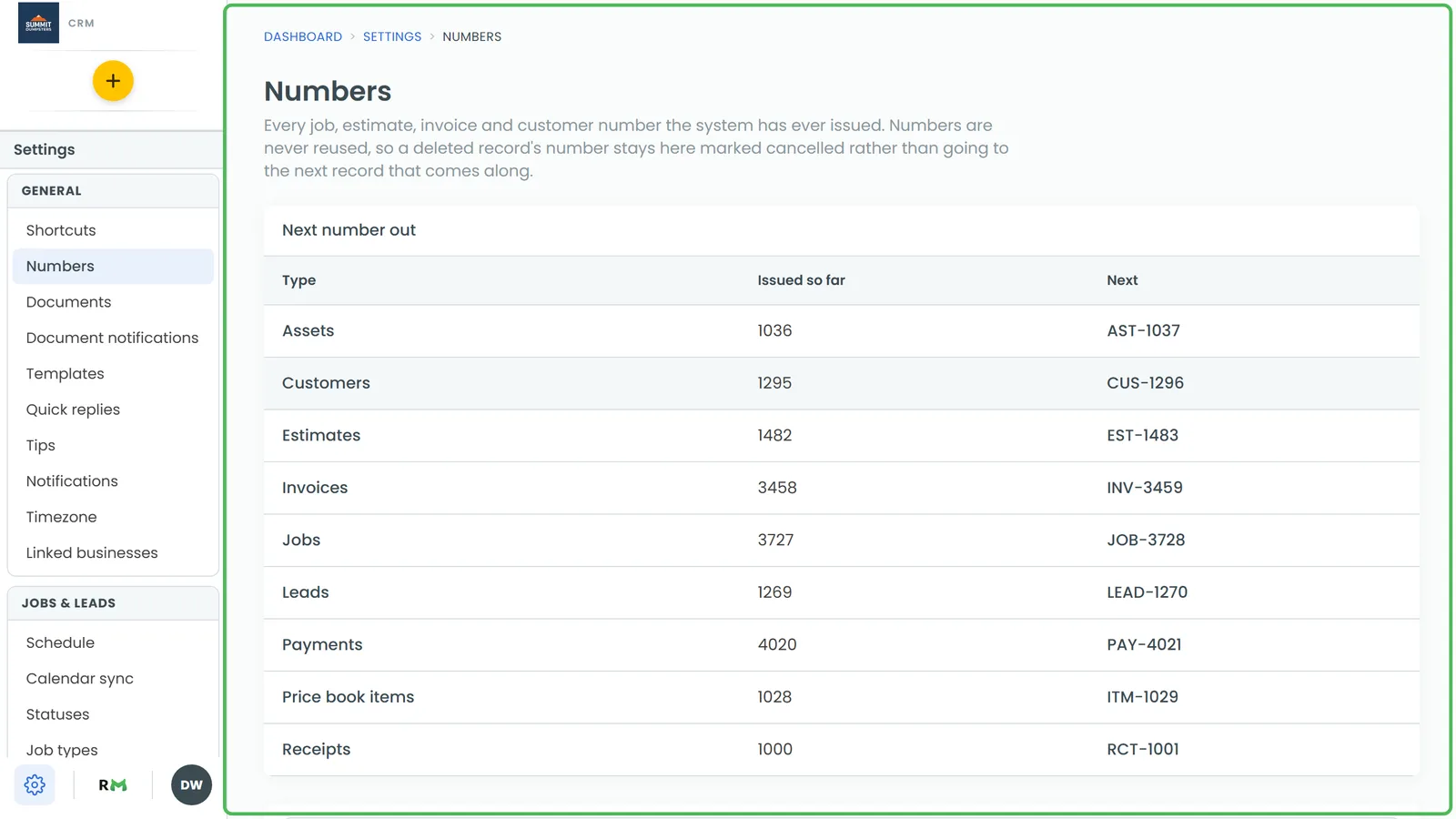
The Next number out table at the top of the page has a row for each type: Jobs, Leads, Estimates, Invoices, Customers, Payments, Price book items, Assets and Receipts.
- Issued so far shows where that type's count is right now.
- Next shows the exact number the next record of that type will get, prefix included.
Look up any number
Below that is a list of the numbers the CRM has issued for your company. Until you search, it shows the 25 most recent.
- Click in the box that says Look up a number, e.g. INV-1001 or 3688.
- Type the number. You can include the prefix, like INV-1001, or type just the digits, like 3688.
- The list updates a moment after you stop typing. There's no search button to press.
Each row shows the Number, its Type, the day it was Issued and its Status. If nothing matches, you'll see "No number matches" followed by what you typed.
Why some numbers are missing or cancelled
Numbers are never reused. If you delete a job, an invoice or anything else, its number doesn't go to the next record. It stays on this list with a status that starts with Cancelled, such as "Cancelled — record deleted". Numbers that still belong to a record show In use.
That's why you'll sometimes see a gap, like INV-1041 followed by INV-1043. Nothing went wrong. A record was deleted, and you can look up its number here to see when it was issued.