In this article, you'll learn how clients and leads differ in the CRM and how they fit together. Once you know which is which, it's easier to chase work you haven't won yet without cluttering your Jobs list.
To open your leads:
- In the menu, click Leads.
To open your clients:
- In the menu, click Clients.
What is a lead?
A lead is a job that might happen. Someone called about a quote, filled in a form or asked for a price, and you don't know yet whether the work will go ahead. A lead is about the work, not the person, so one customer can have several leads over time.
Every lead gets its own number, like LEAD-0089, and keeps it for good. On a computer, type that number into the Filter results box on the Leads page and the lead comes up wherever it sits, even if it was marked lost.
Use a lead when you:
- Get a new inquiry
- Need to go out and quote the work
- Aren't sure yet whether the customer will book
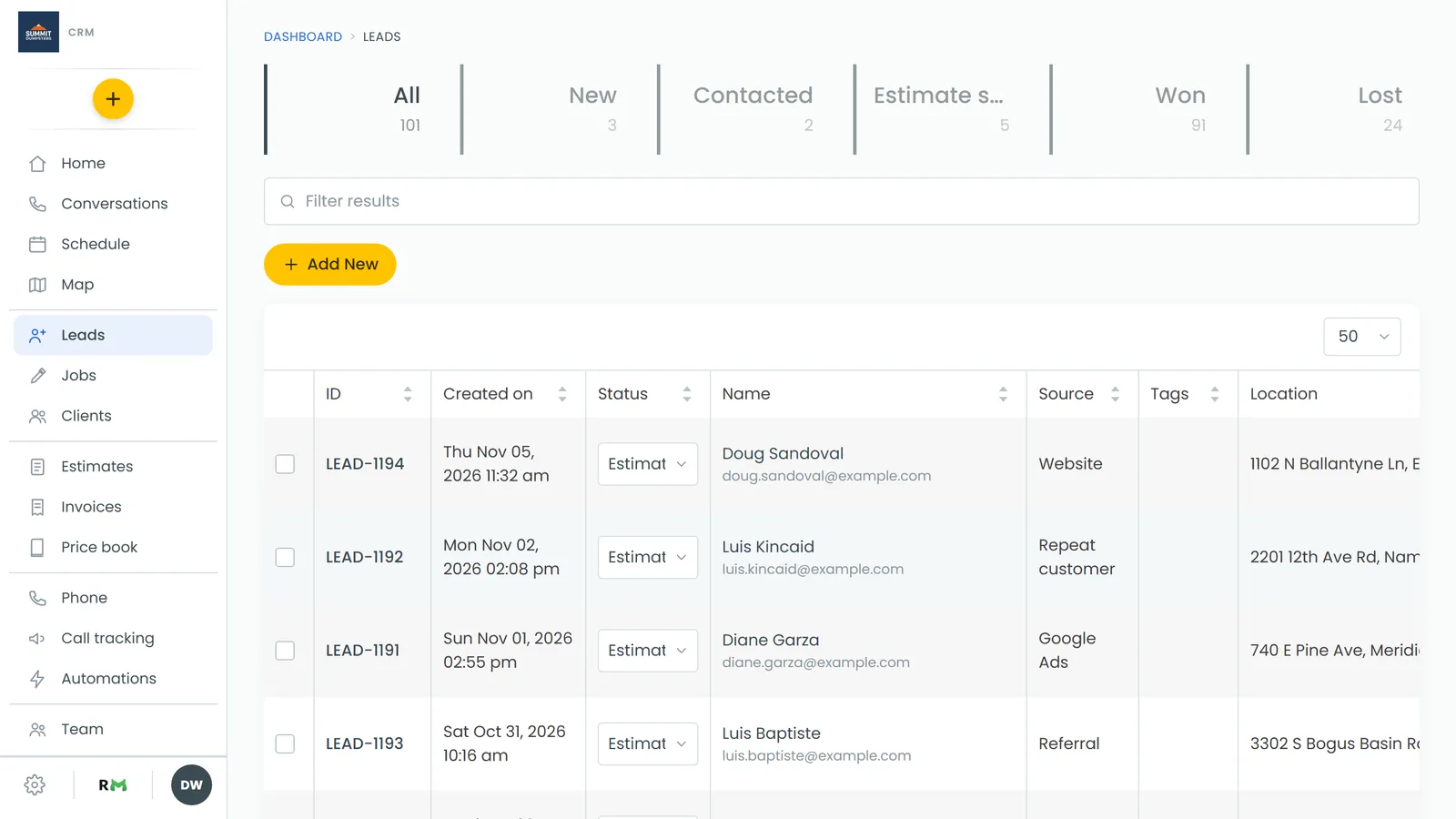
The tiles across the top of the Leads page are your pipeline. All comes first, then your stages in the order you set them in Settings under Lead statuses. Each tile shows how many leads sit at that stage, and clicking one filters the list. Lost leads aren't counted under All, because they've left the pipeline.
On a phone, and in the phone app, the stages run across the top as tabs instead of tiles, with the same Filter results box and Add New button underneath.
Why leads matter
Keeping maybes as leads means your Jobs list only shows real work. A lead you don't win never becomes a job, so you never have to cancel it.
When a lead doesn't work out:
- Click the lead in the list to open its panel.
- Click Mark lost.
- Pick a reason: Price too high, Went with another company, No response, Not a fit for us, Timing didn't work or Other.
- Add a note in the box under the reasons if you want to.
- Click Mark lost again to save it.
The reason stays on the lead and shows in the Became column of the Leads report, so you can see why you're losing work. That's a different question from why a job you'd already booked fell through.
What is a client?
A client is the person or business: their name, phone, email and address. There's one record per customer, however many leads or jobs they have.
A lead is filed under a client. When you add a lead, the name box searches your existing customers as you type, and picking one puts the lead on that customer. If you type in new details instead, the CRM looks for a client with the same phone number, then one with the same email. If it finds one, the lead goes on that client. If not, it makes a new client from the name, company, phone and email you entered. That stops repeat customers from piling up as duplicates in Clients.
What happens when a lead becomes a job
When the customer says yes, click the lead on the Leads page to open its panel, then click Convert to job. On a phone, and in the phone app, the lead's sheet has the same Convert to job button.
Here's what the CRM does next:
- It makes a new job with its own JOB- number. The lead's number doesn't carry over.
- The job is for the same client. It copies the lead's address, phone, email, job type, source, notes, comments, tags and anyone you'd put on the lead. If the lead already had a date, the job gets the same date.
- The job's name is taken from the lead's notes.
- If the client has no address on file yet, they get the job's address.
- Any automations you've set up for new jobs run on it, the same as for a job you typed in.
- You're taken straight to the new job.
- The lead isn't deleted. It stays on the Leads page under its LEAD- number, moves to Won and remembers the job it became. On a computer its panel then says This lead already became a job. and the Convert to job and Mark lost buttons are gone, so it can't be converted twice.