In this article, you'll learn how to read the Items and services report. It shows how many units of each item have gone onto your work and what those lines add up to in dollars. It's a quick way to see what you quote and sell most.
To open the Items and services report:
- In the menu, click Reports.
- Under Business reports, click the Items and services tile.
Understanding the report
The report is a single table with one row per item name and three columns:
- Item: the name on the line.
- Units: the quantities from every line with that name, added up.
- Total: the amounts from every line with that name, added up.
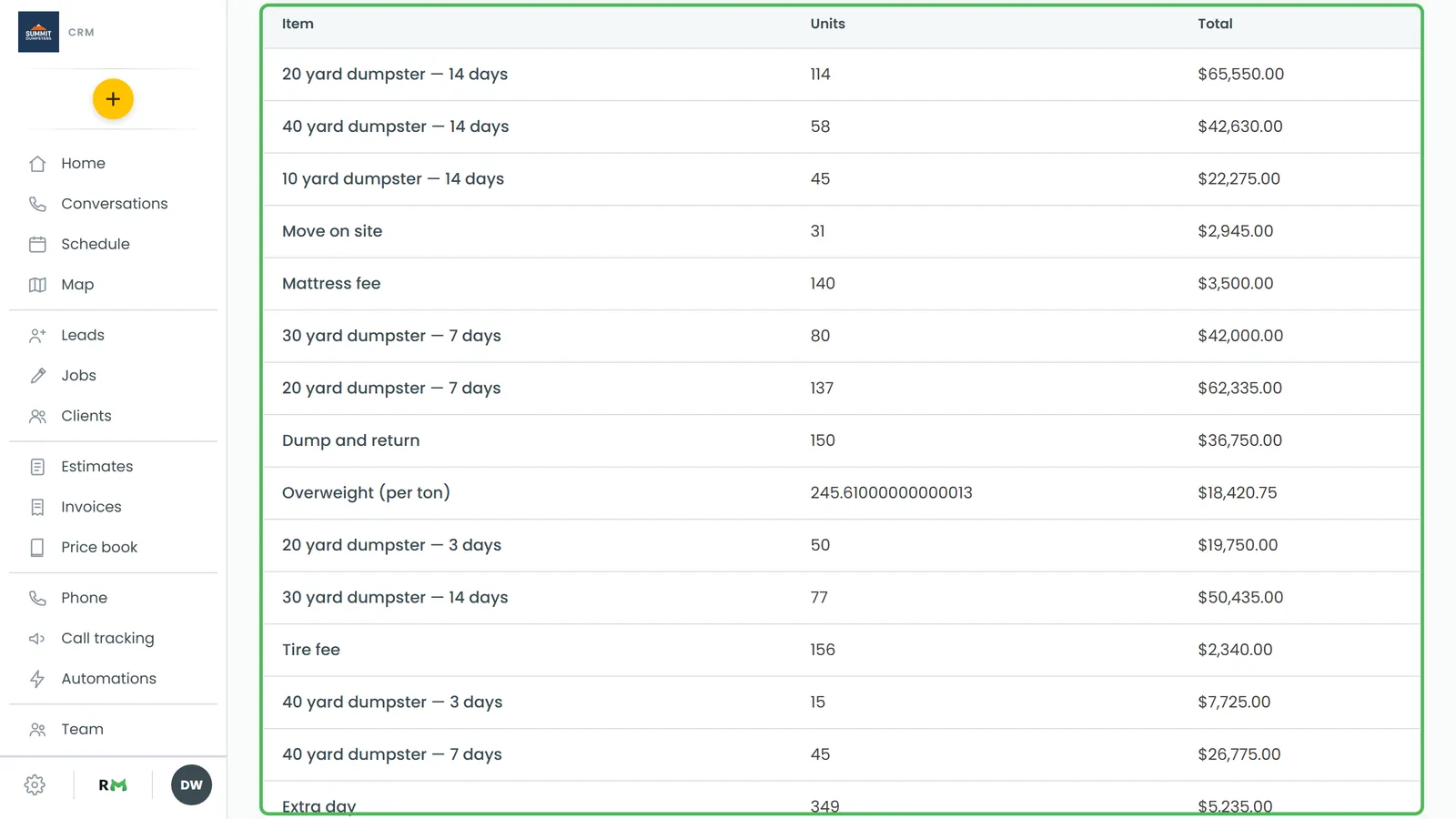
It counts every line item in your CRM: lines on jobs, lines on estimates, and lines on invoices that carry their own items. Invoices raised from a job don't have their own lines, so a job's items aren't counted twice when you invoice it. There's no date range to pick, so the numbers cover everything you've ever entered. You can't filter the rows, they aren't sorted, and there's no export.
If no items have been added anywhere yet, the table just says No item data.
On the phone app
The app shows the same report. Open the menu, tap Reports, then tap Items and services under Business reports. Each item is its own block with its Units and Total underneath. If you have more than fifty items, tap Show 50 more at the bottom to see the rest.
A few things to keep in mind
Rows go by the name on the line
Lines are grouped by their exact name, not by the price book item behind them. Rename an item and new lines show up in a new row, while the old name keeps its own history. Two different items with the same name share a row.
Estimates count too
Estimate lines count whether or not the estimate was ever approved, and that includes optional lines. When you turn an estimate into a job, its lines are copied onto the job. The same happens when you start an estimate from a job's items, duplicate a job, or set up a recurring job. Either way, the same work can show up more than once: once from the estimate and once from each job.
Automatic invoice lines
A few invoices get their own lines without anyone typing them, and those count as well. A recurring billing cycle adds a line for the service and, on the first cycle, one for the setup fee. When a customer approves an estimate that asks for a deposit, the deposit invoice gets a line named Deposit for followed by the estimate number.