In this article, you'll learn where everything lives in the CRM's menu. Once you know the layout, any page is a click or two away, on a computer or on a phone.
On a computer, the menu stays open down the left side. On a phone-size screen it tucks away. You get a dark bar across the top instead, and four pages also get a bar along the bottom.
To open the menu on a phone-size screen:
- Tap the three-line button at the top left.
- To close it, tap anywhere outside the menu. It also closes on its own when you pick a page.
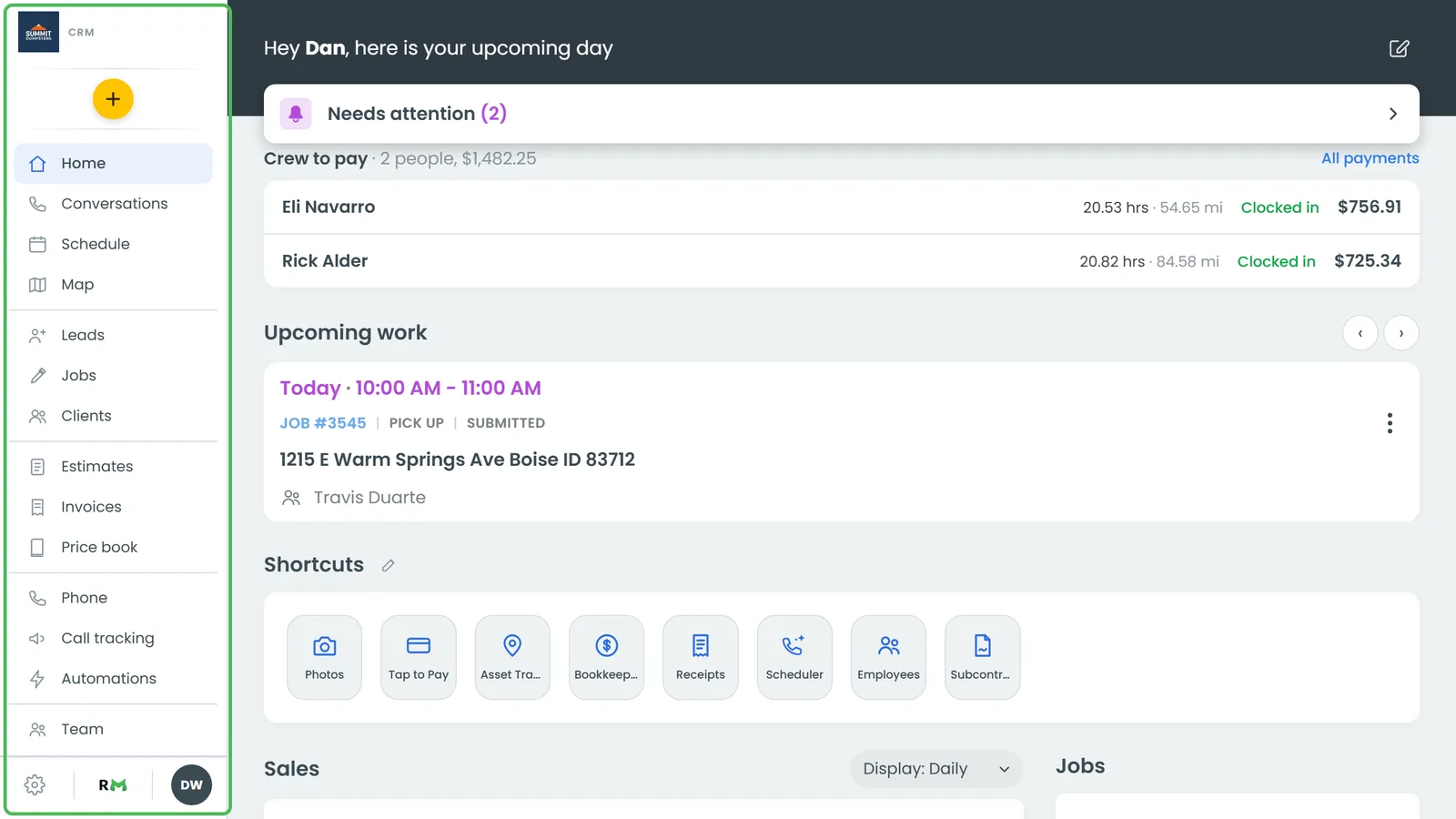
The sidebar
Your logo sits at the top, with a small "CRM" next to it. If you haven't added a logo, your business name shows there instead. Under that is a round yellow + button. The rest of the menu is split into groups, with a thin line between each one:
- Home, Conversations, Schedule and Map: your day, your inbox, your calendar and your jobs on a map.
- Leads, Jobs and Clients: the work and the people it's for.
- Estimates, Invoices and Price book: the money side.
- Phone, Call tracking and Automations: your phone numbers, your tracking numbers and the rules that run by themselves.
- Team: the people who work with you. Team Schedule shows under it once Employees is switched on in Features, and Subcontractors once Subcontractors is switched on.
- Reports and Help Center.
You only see the pages your role is allowed to open. If someone on your team can't find Invoices or Reports, check their role in Settings under Roles & permissions.
Starting something new with the +
Click the yellow + to start something new. You'll see New job, New lead, New note and New client, and below a line, Contact. Contact is how you reach us with feedback or an email.
If you're on a client's page when you click it, New job and New lead open already filled in for that client, and a New estimate for them shows up too.
To close the list without picking anything, click the + again, click anywhere else, or press Esc.
Features
Under the main groups is Features. Click it to open the Features store, where you switch extras on and off. Anything you've switched on, like Photos, Scheduler, Bookkeeping, Receipts, Asset Tracking or Tap to Pay, gets its own row under it. Photos, Receipts and Tap to Pay start switched on. Some rows show a small number on the icon when something new is waiting there.
The Features link itself is for admins. Team members only see the features you've let them use.
Settings, your dashboard and your user menu
A row of icons sits at the very bottom of the sidebar.
To open Settings:
- Click the gear.
- The list slides up above the icons, sorted into boxes: General, Jobs & leads, Money, Phone & booking, Data, Users & roles and Account.
- To close it, click the gear again or click anywhere outside the list.
The gear only shows if your role can open Settings, and inside it you only see the pages your role allows.
Next to the gear is the Review Monster logo. Click it to go back to your Review Monster dashboard. The free CRM doesn't have this icon.
The round button with your initials is your user menu. It shows your name, your business phone number, and whether you're an Admin or a User, with Account and Log out under that. Everyone gets this menu, so anyone can reach their own Account page, even without Settings.
On a phone-size screen
The top bar
On Home, the dark bar has the three-line button, your business name, and three buttons on the right: refresh, the lightning bolt for Automations, and search.
- Search finds jobs, clients, invoices and estimates. Type a job, invoice or estimate number, or a client's name or phone, and results fill in as you go once you've typed two characters. Tap outside the list to close it.
- Refresh pulls a fresh copy of the page without reloading everything.
On the main pages, like Schedule, Conversations, Contacts, Jobs or Invoices, the bar shows the three-line button and the page's name. On anything deeper, like a feature, a settings page or a form you opened from somewhere else, the bar shows a yellow back link instead, labelled Back or with the name of where you came from.
The menu
The menu that slides in from the three-line button has your logo and business name at the top, then the same groups as the sidebar, with a few differences:
- Conversations isn't in it, because it's on the bottom bar.
- Phone opens the dialer, and there's an OMW row.
- Team Schedule is always listed, whether or not Employees is on.
- Subcontractors, when it's on, is listed with your features.
- There's no + in it. Use the one on the bottom bar.
The Settings list here is sorted into General, Jobs & leads, Money, Phone & booking, People & data and Account. At the foot of the menu are three icons: Account, the Settings gear (if your role can open Settings) and sign out.
The bottom bar
The bottom bar has Home, Conversations, Schedule and Contacts, with the yellow + on the right. That + offers New job, New lead, New note, New client and Contact.
The bottom bar only shows on those four pages. When you open a single conversation, a single job or a single client, both bars step aside so that screen gets the whole phone. Use the back arrow at the top to get out.
Good to know
- The phone app's bottom bar has the same four tabs, shows on the same four pages, and its + offers the same list.
- The phone app's menu has the same groups, a Features row with your switched-on features under it, and Account, the Settings gear and sign out at the foot.
- Turn the phone app sideways and the bottom bar becomes a rail down the left edge, with the + at the bottom.